Tonight my daughter had to take an antibiotic. Medicine has always been a huge struggle with her, from the time we had to administer a little liquid children's Tylenol when she was two, up to the present day. Last time we had to do an antibiotic, it was in the form of an evil-looking pink liquid with "cherry" flavoring. Getting it inside her was a daily struggle--tears, wailing, threats, shouting, you name it.
This time the doctor prescribed pills and suggested we crush them and mix them in sorbet or applesauce. Great! So I'm blissfully out on the porch doing some emails this evening, when I hear all hell break loose inside. Apparently tempers had reached the breaking point after an hour of trying to do the medicine thing again. My daughter was near hysterics and my wife was at wit's end. "I'll handle this, " I manfully announced.
I crushed another pill (two had already been sacrificed to the cause) and mixed it in some raspberry sorbet. My daughter eyed me tearfully.
"We tried that. I can taste it!"
"Well," I replied, "I'm sure you can, a little bit. But how bad can it be? Mommy probably didn't mix it up enough. Yummy sorbet, it'll be great, you won't even notice."
"No, I will, " she wailed.
"No, you won't," I said calmly, "just relax! It'll be fine. It's yummy! Look, I'll take bite myself."
I took a tiny nibble of the sorbet with the crushed pill mixed in.
"See, it's fi...UFF! ACK! GAAAAAAAARRRRRRGGGGGGGGHHH. URK! BLLLLEEEEEECCCCCKKKKKHHH. PTOOEY! PTOOEY!"
She was right! It was just incredibly horrible tasting, like eating frozen battery acid, just unbelievable awful. How could a little bit of antibiotic powder completely overwhelm a half a bowl of sweet, delicious, gourmet sorbet?
We're going back to the liquid. At least it's over in five seconds, as opposed to five minutes of choking down a bowl of atomic waste.
Wednesday, July 13, 2011

Thursday, June 30, 2011
Blasts from the Past, Day 30

For my last post I want to discuss some issues, not about the past, but about the future. My featured title is The Rise and Fall of the Third Reich by William Shirer, which I recorded for Blackstone last year.
Now here's a great audio program. It has everything going for it: a evergreen non-fiction title, an epic journey for narrator and listener, and subject matter that never gets stale. It's doing extremely well on Audible and I'm sure it will make a lot of money.
Do I wish I had a little back-end participation? Yeah, that would be nice. Would Blackstone have offered it to me? That's debatable. On a sure money-maker like this, they're probably better off getting me out of the picture as soon as possible, rather than risk paying me three or four times my usual fee over the course of seven years.
Am I sorry? Well, no, because for every book like this, I've done eight or nine that probably won't come even close to making that kind of money. They're good books but they don't have the broad appeal of a book like The Rise and Fall.
Royalty sharing has become an issue lately, and it's worth looking at for a moment. It's not that it can't work. It can if you're very canny, or get lucky and hit the jackpot. But if you don't, the returns may not be what you expected. One problem is that most audiobook rights are limited to 7 years, at which point they revert to the rights holder. They might be renewed, but there's also a chance that they won't or they'll be transferred to someone else. Bear in mind that, of the over 750 titles I've recorded in my career, only about 300 are currently in circulation. Over half my output has disappeared.
Before jumping into anything like this, a narrator would be wise to have some knowledge of trends in the industry, as well as access to research tools like BookScan (though even that won't help with first-time or self-pubbed authors). It's no secret that book acquisition, for anyone except the major publishers with best-selling authors in their stables, is a gamble. Obviously it's worth the gamble, or companies like Blackstone wouldn't be able to stay in business. And with a catalogue of 4000 books, you're likely to pull in a decent profit over the long run.
My point is not to bash the idea of royalty sharing. It's to make it clear that, as more and more narrators are forced into entrepreneurial positions, you have to find out as much as you can about how the business works and how it's changing. And it's definitely changing, with breath-taking rapidity.
I was relieved not to be on a panel at APAC this year because my answer to just about any question about the future of audiobooks would have been,"I have no frickin' clue." Having spent a week in New York at BEA, however, I've got a little better idea. The most encouraging thing about the business right now is that those on the receiving end (talent, producers, directors, and so forth) are very willing to exchange information and insights with each other. This sharing of information is very beneficial, particularly to talent, because until various union efforts and rate scales are settled (if they ever are) the only way to support a stable rate structure is for people on the talent end to know what's going on. This works the other way, too. As a producer, it helps to have some sense of the range of what's acceptable to the majority of narrators. There's always the danger of collusion, but we're a long way from that right now: The market is too fragmented, and there are so many variables to take into account--timing, schedules, location, experience levels, book length and complexity, special language or character skills, and so on. Price is just one consideration in the production process. In fact, I think it would be very healthy to see more freedom of negotiation in the rate structure depending on all these factors.
About 90 percent of audiobook production is based on relationships. This is perfectly logical--you don't trust someone to do a 15 hour book in two weeks if you have no idea who they are. It also behooves me from a casting point of view to know who my narrators are, what they like and how they work. When these relationships are not fully engaged in and realized, the production process falters, sometimes disastrously. Maintaining these relationships is about 50% of my job as a producer who relies on a consistent stable of available readers.
As JIAM draws to a close today, my hat is off to all the new people coming into the business who have negotiated a path through what is still an incredibly loosely-structured, Wild West sort of industry. It's about to get wilder. Stay informed, ask questions, learn as much about the business as you can. Don't be afraid to pump people for information. The more you know, the better you'll be able to benefit from the changes going on as we speak.
Blasts from the Past, Day 29

Napolean Hill.
What is it about this guy? He's the self-help guru to end all self-help gurus. Eighty years later he's still going strong. You can get his books for free from various web sites. You can buy deluxe editions of them. You can download numerous audio versions. It doesn't seem to matter, the guy has a huge following and people will pay whatever to read him.
He puts forth some pretty wacky ideas, from "mind-meld" to "atmospheric vibrations," some of which make a little sense if you believe in "karma" or things like that. His behavioral insights are generally sound, though. Always do more work than is required of you. Be pleasant, positive and cooperative. Work as a team and draw on the intelligence and experience of others to help you get ahead. Take care of your health and mind your hygiene.
This is useful stuff, and though it's presented as an astonishing set of revelations, it's nothing common sense wouldn't dictate. But back in the day, before there was a real middle-class, this advice to people seeking advancement was no doubt highly pertinent.
He's very entertaining to narrate, I'll give him that.
Wednesday, June 29, 2011
Blasts from the Past, Day 28

The Wall by Jeff Long was the first book I recorded for Tantor Media in 2006. It was nominated for an Audie Award in 2007. This was kind of startling to me because, as much as I enjoyed it, I hadn't been quite sure what to make of it when I was narrating it. Part action novel and part mystical ghost story, it doesn't fit snugly in either category. It's not that I want to pigeonhole books when I narrate them, or resort to a "stereotyped" read, but it helps to be able to determine what sort of audience the book will appeal to. This one was hard to pin down. The writing was excellent and the images were vivid enough to stay with me all these years.
Today I got curious and looked up Jeff Long on Amazon, and I understand a bit more about him now. The Wall is in fact typical of his writing, which blends mystery, adventure and the supernatural in a way that defies easy categorization. Surprisingly, none of his other books are currently available in audio, which seems odd because the descriptions are appealing, the reader comments are strong and at least a couple of them have decent sales rankings. In fact, they look downright interesting. I may purchase a few for vacation reading.
Tuesday, June 28, 2011
Blasts from the Past, Day 27

I mentioned Gore Vidal's series of historical novels in my first post. The recordings I did are long out of print, but if you enjoy historical fiction, delivered with a gimlet eye and healthy dose of (mostly cheerful) cynicism, you should pick up this series for summer reading. Burr is excellent, and the later novels spin out the family saga sub-plot in a clever way, but Lincoln is the jewel in this richly figured crown--probably one of the best historical novels of the last century. The author's fondness for his subject is obvious on every page. His portrait of Lincoln is deeply affectionate and fully fleshed out. You feel you get to know Lincoln in a way few other novelists or biographers have managed. Whenever I read a book about Lincoln these days, I can't help picturing Gore Vidal's Lincoln, a complex, humorous and immensely loveable figure.
What I never knew until I scouted around on Amazon looking for a copy of my old recording, is that Vidal himself recorded an abridged version for Random House. You can pick one up for as little as $4. I imagine the entertainment value would be well worth the price--plus the trouble of digging out an old cassette player to hear it.
Monday, June 27, 2011
Blasts from the Past, Day 26
I know I'm going to hell for yesterday's post. Let's see, which famous author or high-end publisher can I offend today?
We might as well get this out of the way: What's the worst book I've ever recorded?
Without question, hands-down, no-brainer, it was The Cry of the Panther by James. P. McMullen.
It was a well-intentioned effort, I suppose: A memoir by a Vietnam vet who, struggling to exorcise the demons that haunt him, immerses himself in a hunt for an elusive black panther named Shakespeare who lurks in the gloom of the Everglades.
And when I say immerses, I mean it. In one unforgettable passage, he douses himself in panther urine and buries himself in swamp muck up to his eyes, all the while chanting "I am a panther, I am a panther, I AM a panther." Reading that with a straight face was one of the challenges of my career.
It got to the point where both the engineer and I concluded that it had to be a hoax. Nothing about the story made sense. When, after hundreds of pages of tortured prose, he finally meets up with Shakespeare and they exchange a "meaningful" glance, we both howled. That's it? We waited four hundred pages for this?
I recall that the book received a plug from James Dickey, which makes sense in a perverse sort of way.
I know I'm going to get an email from James McMullen's son or niece or someone close to him, saying that this book saved his life. Or some vets' organization will tell me how meaningful it was to them. I can't even find a picture of the cover, though it's still listed on Amazon with, astoundingly, a handful of five-star reviews. If you're still out there James, I'm sorry. But it was murder to pull this one off.
Regardless of whatever backlash I might incur, I've answered the question that only the boldest of interviewers dares to pose.
UPDATE: I found an old People magazine article dated from the time the book appeared. "The Scatman"--I'd forgotten that part! I guess the book really meant something to him, so I feel bad. But it really was a grueling read.
We might as well get this out of the way: What's the worst book I've ever recorded?
Without question, hands-down, no-brainer, it was The Cry of the Panther by James. P. McMullen.
It was a well-intentioned effort, I suppose: A memoir by a Vietnam vet who, struggling to exorcise the demons that haunt him, immerses himself in a hunt for an elusive black panther named Shakespeare who lurks in the gloom of the Everglades.
And when I say immerses, I mean it. In one unforgettable passage, he douses himself in panther urine and buries himself in swamp muck up to his eyes, all the while chanting "I am a panther, I am a panther, I AM a panther." Reading that with a straight face was one of the challenges of my career.
It got to the point where both the engineer and I concluded that it had to be a hoax. Nothing about the story made sense. When, after hundreds of pages of tortured prose, he finally meets up with Shakespeare and they exchange a "meaningful" glance, we both howled. That's it? We waited four hundred pages for this?
I recall that the book received a plug from James Dickey, which makes sense in a perverse sort of way.
I know I'm going to get an email from James McMullen's son or niece or someone close to him, saying that this book saved his life. Or some vets' organization will tell me how meaningful it was to them. I can't even find a picture of the cover, though it's still listed on Amazon with, astoundingly, a handful of five-star reviews. If you're still out there James, I'm sorry. But it was murder to pull this one off.
Regardless of whatever backlash I might incur, I've answered the question that only the boldest of interviewers dares to pose.
UPDATE: I found an old People magazine article dated from the time the book appeared. "The Scatman"--I'd forgotten that part! I guess the book really meant something to him, so I feel bad. But it really was a grueling read.
Blasts from the Past, Day 25
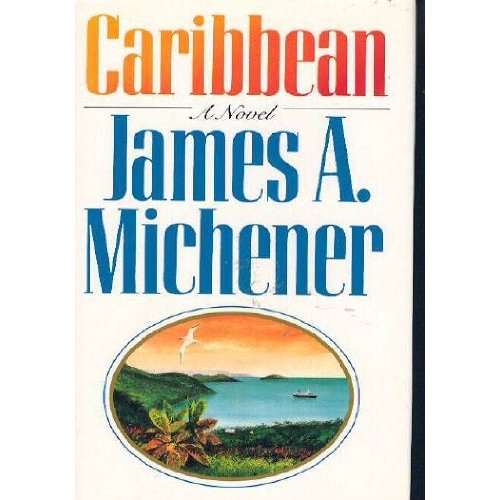
Pace, James Michener.
I did two of his sprawling, noodle-headed behemoths for Books On Tape in the 90's, Caribbean and Mexico. I also recorded The World is My Home, a sort of random memoir about his travels, and The Novel, which was actually an interesting look at the publishing industry from a writer's point of view.
How many of these "blockbusters" did he write, anyway? At least a dozen: Texas, Hawaii, Alaska, Chesapeake, Iberia, Poland (!)...the list goes on and on. My parents loved these things, as well as the prolific Irving Stone. I guess it was "substantive" reading for people who didn't like to read that much. They were almost impossible to manage from a narration standpoint: a unending flash flood of under-developed, two-dimensional characters and sub-plots that raced along without ever developing any teeth or guts. It was like an automated panorama at a hi-tech amusement park that just keeps scrolling past you, devoid of thought or emotion. I ran out of voices about halfway through the first one. A tremendous amount of work with very little payoff.
The first time I ever turned down work was when BOT proposed sending me a third one, and I said I'd had enough, maybe someone else would enjoy it more than I would.
Question: Would anyone want to hear these again? If so, I've just botched my chance at recording them.
Subscribe to:
Posts (Atom)
